Cyclooxygenase inhibitors, NSAID - Aspirin
Aspirin or acetylsalicylic acid occupies a particular place among non steroidal anti-inflammatory drugs.
It acts as a donor of an acetyl group, -CH3-CO, and is converted into salicylic acid, its principal metabolite. The acetyl group binds to the OH group of a serine residue of the cyclooxygenase protein. It thus inhibits cyclo-oxygenases in an irreversible way. Aspirin reduces the activity of fibrinogen and in large doses decreases prothrombin time.
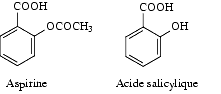
Recently, it was shown that aspirin, by acetylating a metabolite of arachidonic acid, leads to the formation of a lipoxin derivative which reduces cellular adhesion. Aspirin like its metabolite, salicylic acid, inhibits ETA endothelin receptors. Other mechanisms were also proposed to explain the beneficial effects of aspirin.
- Cardiovascular action
In small doses (50 to 150 mg/day for an adult), it inhibits preferentially platelet cyclooxygenase and thus reduces the production of thromboxanes which induce platelet aggregation while respecting, at least partially, endothelial cyclo-oxygenases responsible of the synthesis of PGE and PGI2 which inhibit platelet aggregation. The platelet being a cell without a nucleus, there is no new enzyme synthesis, which explains the long duration of inhibition. The antiplatelet effect and the prolongation of bleeding time induced by aspirin are explained by the preferential inhibition of the platelet cyclooxygenase.
- Anti-cancer action
The majority of the epidemiologic studies show that aspirin inhibits the development of certain cancers (colon, lung, breast cancers), but its efficacy would be better with dosages higher than those which are used in cardiology.
- Antiinflammatory, antalgic and antipyretic action
In large doses (0,5 to 2 or 3 g/day), aspirin has antiinflammatory, antalgic and antipyretic effects. With these doses, it is especially used as an analgesic and antipyretic. Generally, a fever lower than 39°C should not be treated by an antipyretic.
Its use as an antipyretic or antalgic in children must be avoided because, in general the fever has an antiviral beneficial effect and aspirin seems to increase the risk of Reye's syndrome.
In the event of overdose, one observes, particularly in infant poisonings neurological and respiratory disorders.
To conclude, aspirin is a drug which, with low doses, about 50 to 150 mg/day, reduces the frequency of cerebral and cardiac thromboses and inhibits the growth of colon tumors and with higher doses, 500 mg by intake, is effective as an analgesic.
Notice
Salicylic acid is used in ointments or lotions for its keratolytic effect for the treatment of cutaneous hyperkeratotics or scaly lesions.
|


