Cyclooxygenase inhibitors, NSAID - Conventional NSAID, inhibiting COX-1 and COX-2
The international common names of the principal nonselective NSAID, apart from aspirin which is studied separately, are indicated below.
Ibuprofen |
ADVIL * Tablets, Caplets
|
Naproxen |
NAPROSYN * Tablets, Suspension |
Diclofenac |
CATAFLAM* Tablets |
Piroxicam |
FELDENE * |
Indométacin |
INDOCIN* Capsules, Oral suspension, I.V |
Sulindac |
CLINORIL* Tablets |
Meloxicam, nimésulide and nabumetone are sometimes classified among the preferential COX-2 Inhibitors , i.e. inhibiting COX-2 more than COX-1.
Meloxicam |
MOBIC * Tablets |
Nabumetone |
RELATEN* tablets |
NSAID are used:
- In the long courses as supportive care of chronic inflammatory rheumatisms, rheumatoid arthritis and ankylosing spondylitis and osteoarthritis
- during short duration as treatment of arthritis, periarthritis, tendinitis, lumbagos etc
Certain NSAID are used more for their antalgic property which is obtained with dosage lower than that which is necessary to obtain an antiinflammatory effect. Ibuprofen which seems one of the anti-inflammatory drugs best tolerated, in particular on the gastric level, can be used as a of first-line NSAID but also as an analgesic.
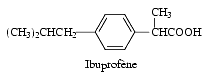
Ibuprofen, ketoprofen and fenoprofen are often prescribed as analgesics. They give for example interesting results, in intramuscular injection, in the treatment of the renal colics.
Indomethacin is the NSAID which was used the most frequently in new-born babies to accelerate the closing of theductus arteriosus. Ibuprofen may give results similar to indomethacin in this particular use.
Certain NSAID exist in the form of ophthalmic solution for treatment of post-operative ocular inflammatory symptoms. They are indomethacine, flurbiprofen and diclofenac.
Flurbiprofen |
OCUFEN * Ophthalmic solution |
Diclofenac |
VOLTAREN * Ophthalmic solution |
|


