Potassium - Biological functions
Potassium plays a determining role in the cellular repolarization. Depolarization caused by sodium and calcium influx is followed by repolarization caused by potassium efflux. The return of the cell to the state of initial or resting equilibrium is achieved by membrane Na+/K+-ATPASE.
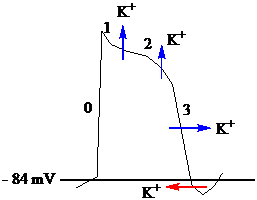
Transfert of K+ during the action potential (phase 0, 1, 2 and 3) in blue exit, the red possible entry, the responsible for K+ entry in the cell is the NA+, K+- ATPase pump, not represented.
The exchanges of potassium between the cell and the extracellular fluid are carried out by different structures:
- Na+/K+-ATPase pump which, each cycle, extrudes three sodium ions and enters two potassium ions ( See “Na+/K+-ATPASE and inhibitors (Digoxin)”. ).
- C arriers, in particular cotransporters like Na+/K+-2Cl- ( See “Loop diuretics of Henle”. ).
- Channels whose opening allows a passive transfer of K+. The transfer can theoretically be bidirectional, from the interior of the cell outwardsor the reverse. The direction of the transfer depends on the concentrations of potassium inside and outside the cell and of the potential difference between the interior and outside. As the intracellular concentration of K+ is very high (approximately 150 mmol/L) and the extracellular concentration low (approximately 5 mmol/L), at the opening of potassium channels, in general, K+ leaves the cell. These transfers are done at high speed but concern only a negligible amount of K+ions compared to the total quantity.
The selectivity of potassium channels with respect to other cations depends on the narrowest part of the channel. This is generally too small to be permeable to ions larger than potassium, either in the hydrated state (case of lithium), or in the non hydrated state.
The opening of potassium channels depends on the changes in cellular polarization, on the concentration of certain intracellular ions and on transmitters; there are several types of channels:
- The opening of voltage-gated K+ channels can be fast or delayed and of more or less duration. There are several types of channels: KA whose opening is of short duration, Kv “delayed rectifier whose opening is delayed but is prolonged, KVr and KVs (R for fast activation and S for slow activation). These channels open with the depolarization induced by the fast sodium influx. They play an essential part in the cellular repolarization.
A defect of opening of late potassium channels (delayed rectifier current) delays the repolarization and can be at the origin of the long-QT syndrome, in the same way as a sustained sodium influx ( See “Sodium and drugs”. ).
- Channels coupled with sodium and calcium ions. The intracellular increase in sodium and especially in calcium induces the opening of these channels inducing a potassium efflux. One distinguishes three types of Ca2+ -dependant K+channels/: BKCa, IKCa and SKCa (B = big, I = intermédiary, S = small).
- Channels coupled to transmitters. Among the transmitters acetylcholine and adenosine play an important part.
At the level of the heart, acetylcholine induces the opening of potassium channels, increase in cellular polarization by efflux of potassium and decrease of excitability causing cardiac slowing.
At the level of the pancreas, the increase in intracellular ATP induces the closure of the potassium channels inducing depolarization and influx of calcium into the cell, and increase in insulin secretion. Intracellular ADP has the inverse effect. Extracellular ATP and ADP are without effect.
Other transmitters are involved, for example serotonin which induces the closure of certain potassium channels and depolarization.
Potassium channels depending on oxygen concentration are present at the level of carotid receptors
Whatever the potassium channel implicated, the potassium efflux, i.e. the loss of positive charges, increases the polarization of the cell or accelerates its repolarization after a depolarization. Conversely the closure of potassium channels decreases polarization and delays repolarization.
In addition to its effect in cellular polarization, potassium is an enzyme activator implicated in some phosphorylations.
Notice:
When the concentrations of K+ inside and outside the cell are 140 mmol and 5 mmol per liter, respectively, and the potential difference - 84mV, influx and efflux of K are compensated. When the extracellular concentration of K+ increases and/or when the potential difference exceeds - 84mV, the transfer of K+ from outside inwards becomes possible. The channels which are open under these conditions are named Kir (invardly rectifying K+ channel). These channels, whose function is controlled by magnesium and polyamines, play an important part in the regulation of the resting membrane potential of the cell.
|


