Intercalating antineoplastic agents and free radical inducers
Certain drugs having a plane molecular structure can be intercalated between two strands of DNA and are called intercalating agents. In general, the intercalation alone is not sufficient to disturb replication and transcription. The drug intercalated damage DNA generally by formation of free radicals. Sporalens illustrate this aspect: in absence of light they intercalate between DNA strands without damaging, in the presence of light they cause damage.
The intercalating agents are anthracyclines, bleomycin and different other molecules.
Anthracyclines and related compounds
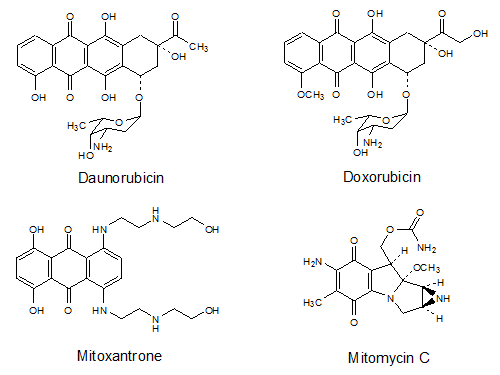
Anthracyclines are of fungal origin. They intercalate between the DNA strands that they cut by hydrolysis in the manner of nucleases; they can also induce membrane damage. Their pharmacological activity results from oxydoreduction reactions with formation of a semiquinone intermediate by gain of an electron yielded by NADPH and generation of hydrogen peroxide, H2O2, of oxygen free radicals and · OH. The formation of free radicals is potentiated by the presence of iron and copper.
The main anthracyclines are daunorubicin (Cerubidine*, DaunoXome*), doxorubicin (Caelyx*, Myocet*,Doxil*), epirubicin (Farmorubicin*, Ellence*), and idarubicin (Zavedos*, Idamycin*).
Concerning pharmacokinetics, they are given by intravenous route, generally in perfusion, and their plasma half-life is short. The P-glycoprotein decreases their activity by extruding them out of cells. The encapsulation of doxorubicin and daunorubicin in liposomes modifies their pharmacokinetic characteristics with a better penetration in certain tumors
The clinical uses of the anthracyclines are leukemias, lymphomas and different solid tumors.
Adverse effects of anthracyclines are myelosuppression and especially cardiotoxicity which can appear even after the discontinuation of the treatment. The compound used as antidote of the cardiotoxicity of anthracyclines is dexrazoxane, (Cardioxane*, Zinecard*).
Mitoxantrone, (Novantrone*) is an anthrancenedione structurally related to doxorubicin. Its clinical uses are acute myeloblastic leukemias, non-Hodgkin's lymphomas and metastatic breast cancer.
Mitomycin (Mutamycin*) can act as an alkylating agent by its aziridine ring. Moreover, like anthracyclines, it gives free radicals by formation of a semiquinone. It is used in for the treatment of different solid tumors.
Bleomycin
Extracted from Streptomyces verticillus, bleomycin is a mixture of two products called bleomycin A2 and B2. Bleomycin is a chelator which, in the presence of a reductant, RSH, of oxygen and an element iron or copper, elicits the formation of free radicals which damage DNA. The active form could be the complex bleomycin-iron which releases · OH radicals.
The clinical uses of bleomycin (Bleo*, Bleoxane*) are squamous carcinoma, head and neck, skin, bladder and testicle cancers.
Bleomycin has little toxicity for bone marrow, but it has a pulmonary toxicity and the advent of cough or shortness of breath can be signs of pulmonary fibrosis.
Other antineoplastic agents
- Dactinomycin or actinomycin D
Dactinomycin, produced by certain types of Streptomyces, has a phenoxazone nucleus which intercalated between DNA strands forms a complex dactynomycin-DNA blocking transcription. It has antibiotic properties non used because of its toxicity. It potentiates the effects of radiotherapy. Dactinomycin (Cosmegen*) is used in the treatment of different types of neoplasms.
Dactinomycin is a toxic product whose contact with the skin or the mucous membranes during the preparation of solutions to be administered must be avoided.
- Plicamycin or mithramycine.
Plicamycin has a mechanism of action rather similar to dactinomycin. It has, moreover, a hypocalcemic effect and was used in the treatment of hypercalcemia. It was marketed under the name of Mithacin*.
- Amsacrine
Amsacrine (Amsidine*) is an intercalating agent and an inhibitor of topoisomerase II, used in the treatment of leukemias.
- Elliptinium
Elliptinium is an intercalating agent having also a membrane effect. It is not marketed any more.
|


