Bacterial transcription inhibitors
RNA polymerase ensures the transcription of the information contained in DNA from DNA to mRNA. The gene, fragment of DNA, is the informational unit. Transcription of DNA into mRNA is done in the presence of ATP, UTP, GTP and CTP through RNA-polymerase-DNA-dependent, which catalyzes the elongation of the chain. The activity of RNA polymerase is controlled by activator and repressor proteins.

The reading for transcription begins at the promoter, area of regulation of the coding domain of DNA. The RNA-polymerase identifies the promoter, binds to it. Initiation elicits the spacing of the two strands which constitute a bubble where transcription is carried out. mRNA, resulting from the transcript, undergoes modifications or maturation such as intron splicing, to be converted into a functional structure .
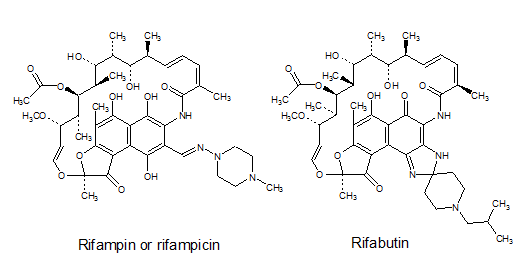
Rifamycins, macrocyclic antibiotics produced by Streptomyces mediterranei, inhibit the bacterial RNA polymerase, by binding to the beta subunit, which is one of the five subunits of the enzyme: They have little action on the human RNA polymerase. This group of antibiotics includes rifampicin, rifabutin and rifamycine SV.
- Rifampin
Rifampin, also called rifampicin, has a bactericidal activity against a wide range of microorganisms, of which Mycobacterium tuberculosis and Mycobacterium lepræ as well as staphylococci, streptococci, Neisseria, Listeria monocytogenes, Brucella…
It is used as antituberculous drug, always combined to two or three other drugs to avoid the emergence of resistance and as anti-leprous drug. Its other clinical uses are brucellosis and the prophylaxis of meningococcal meningitis.
A pharmacokinetic characteristic of rifampin is to be a microsomal enzyme inducer of most cytochrome P450 isoforms. It can accelerate the inactivation of many drugs among which oral contraceptives, or cause attacks of porphyria in porphyric patients. Among its other potential adverse effects, it can cause a flu-like syndrome.
Resistance to rifampin is explained in certain cases by its ribosylation i.e. by the binding of a sugar via the ADP-ribosyl transferase produced by the resistant microorganism.
Rifampicin (Rifadin*, Rimactan*) is marketed alone and in combination with isoniazid (Rifinah*) and with isoniazid and pyrazinamid (Rifater*).
- Rifapentine
Rifapentine is a rifampin analog used in certain countries for tuberculosis therapy.
|


