Enkephalinomimetic drugs - Morphine analgesics with agonist and antagonist effects
A certain number of compounds synthesized in order to replace morphine have the analgesic properties of morphine but can reverse the effects of morphine when they are given after it. One can classify in this group pentazocine, nalbuphine and buprenorphine.
Pentazocine
Administered to a patient in pain but not having taken morphine, pentazocine has an analgesic action quite similar to that of morphine. Administered to a morphine addict, it can induce the onset of a withdrawal syndrome by antagonizing morphine. This paradoxical effect may be explained by the fact that pentazocine has a high affinity and a low activity with respect to the morphine receptors. Administered alone, it stimulates them; administered after morphine, it takes its place on the receptors without having the same efficacy. Addiction to pentazocine may be less than that of morphine but its advantages compared to morphine are not obvious. Its principal secondary effects are sedation, dizziness, vomiting and, with strong doses, respiratory depression.
Nalbuphine
Nalbuphine is a major analgesic whose efficacy is quite similar to that of morphine. It is mainly an agonist of K receptors. It antagonises certain effects of morphine, because of a partial antagonist effect on mu receptors . It causes a respiratory depression whose antidote is naloxone. It is not spasmogenic nor histamino-liberating. Brutal discontinuation of nalbuphine can be followed by a withdrawal syndrome, however less important than that of morphine,
Buprenorphine.
Buprenorphine is a morphinomimetic derived from thebaine, having a major analgesic effect, equivalent to that of morphine, which lasts approximately eight hours and which is obtained with a dose approximately ten times lower than that of morphine. It is a partial agonist at the mu-opioid receptor and has some antagonist effect at the kappa-opioid receptor.
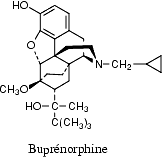
It is used as an analgesic and, with higher dosage as a drug of substitution for morphine in drug addicts. The combination of buprenorphine and naloxone is only used for opioid dependence.
Buprenorphine |
BUPRENEX Injectable
SUBUTEX* Sublingual tablets |
Buprenorphine + Naloxone |
SUBOXONE* Sublingual tablets |
Buprenorphine appears to have a lower potential for producing dependence than morphine .Its brutal cessation induces symptoms less intense and more delayed than those which follow morphine withdrawal.
Buprenorphine can cause respiratory depression poorly reversed by the administration of naloxone, undoubtedly because of its high affinity for the opioid receptors. The respiratory depression it induces appears especially with first intake and with high dosage and is worsened by concomitant benzodiazepine intake.
Intake of buprenorphine by a morphine addict who has just taken morphine or heroin, or methadone, can elicit a withdrawal syndrome because of the agonist-antagonist character of buprenorphine.
|


