Enkephalinomimetic drugs - Morphine
The principal enkephalinomimetic drug, morphine, is a pure opioid agonist which exerts its effects mainly through mu opioid receptors. Morphine was at the origin of the discovery of enkephalinergic receptors and enkephalins, and not the inverse. It is extracted from opium which is obtained by incision of the capsules of the poppy, Papaver somniferum. Recent studies showed that animal and human cells could synthesize very low morphine traces whose possible role remains to be determined.
Morphine is the active metabolite of several compounds: codeine, codethyline also called ethylmorphine, pholcodine, heroin.
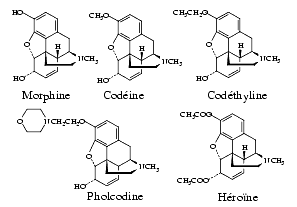
At therapeutic dose, approximately 10 mg by intravenous or intramuscular injection, morphine has, in addition to its analgesic effect, many other effects.
Analgesic effect
Analgesia is the principal effect of morphine which relieves the majority of painful syndromes.
- It increases the threshold of pain perception: the sensitivity to noxious stimuli (electric, chemical, mechanical) is specifically decreased. There is decrease of painful perceptions without modification of other perceptions: vision, hearing, touch.
- It modifies pain perception: for certain patients, the pain is always present, but morphine induces a certain detachment with respect to it.
- It decreases objective (cries, moaning), subjective (apprehension, interpretation) reactions to pain.
- The analgesic action of morphine following systemic parenteral administration lasts about 4 to 6 hours and results from its action on several levels: cerebral, spinal, peripheral. The peripheral action of morphine is demonstrable: administered topically by intra-articular route, in the knee for example, it causes a localized analgesia.
Behavioral effect
Morphine administration at therapeutic dose induces, in a patient who suffers intensely, decrease or disappearance of pain, drowsiness with a certain euphoria, impression of wellbeing, indifference to troubles.
In a normal pain-free subject, non-dependant, its effects are rather unpleasant: there is dysphoria with anxiety, nauseas, vomiting.
Effect on respiration
Morphine causes respiratory depression: even in small doses, it decreases respiratory rate and amplitude. This respiratory depression develops parallel to the analgesic effect and appears in five minutes or an hour according to its mode of administration. It is explained by a decrease in the sensitivity of the respiratory centers to CO2. It is the decrease in the oxygen concentration which becomes the principal stimulant and, under these conditions, oxygen therapy can produce apnea.
From this depressor effect on respiration results an application, the use of morphine derivatives, codeine especially, as antitussive agents, and a contraindication, its use in patients with respiratory impairment.
Ocular effects
Morphine elicits miosis which persists even in darkness. During morphine overdosage and in morphine addicts, pupils are pinpoint. Miosis results from mu and kappa receptor stimulation via activation of the parasympathetic system. Atropine reduces miosis induced by morphine.
Cardiovascular effects
At therapeutic doses, morphine has little effects on the cardiovascular system in supine patients. In an upright subject, a vasodilation, perhaps linked to histamine release, can cause postural hypotension.
Digestive effects
Schematically, by its effects on central and peripheral receptors, morphine decreases digestive peristalsis (gastric and intestinal) and lowers aqueous secretion, inducing constipation. Morphine derivatives such as diphenoxylate, loperamide are used as antidiarrheal agents.
Used as an analgesic for treatment of colic pain, an antispasmodic should be associated with it.
Nausea and vomiting induced by morphine are due to the stimulation of the “chemoreceptor trigger zone”, CTZ, and not to its direct spasmogenic effect.
Neuroendocrine effects
The hormonal effects of morphine are primarily at the hypothalamo-pituitary level: decrease of LH, FSH, ACTH secretion and increase of prolactin secretion by reduction in the action of dopamine.
Tolerance and dependance
- Tolerance
Tolerance to morphine results in a decrease in its effects following repeated administrations. This tolerance whose importance was perhaps exaggerated, can be dissociated, for example the analgesic effect attenuating more quickly than miosis and constipation. NMDA antagonists and inhibitors of biosynthesis of NO could reduce tolerance to morphine.
- Dependance
Morphine induces psychic and physical dependance. Dependance seems to result from an activation of the dopaminergic system which is tighly linked to the enkephalinergic system. The brutal discontinuation of morphine in a morphine addict results in a withdrawal syndrome. The symptoms appear approximately 8 to 12 hours after stopping morphine: anxiety, apprehension, lacrymation, rhinorrhea, cough, sweats. One also observes: a rise in temperature, insomnia, headache, mydriasis, hypertension, nausea, hypersalivation and diarrhea.
Withdrawal syndrome can also be observed in the new-born baby when his mother was taking morphine during pregnancy. In this case, at birth, one observes in the child hypereractivity, cries, tremors, accelerated respiration, diarrhea, fever,.
Clonidine, a presynaptic alpha-2 adrenergic stimulant, attenuates the morphine withdrawal syndrome by inhibiting the increased catecholamine release.
Morphine addiction consists of a compulsive use of morphine or of its analogues.
Metabolism
- Administration
In opioid-naïve patients with acute pain, the usual route of administration of morphine is the parenteral route with the dose of 10 mg, renewable.
In chronic pain, morphine can be administered by oral route, although its bioavailability is low, about 25%. This low bioavailability which results from an incomplete absorption and an inactivation by first-pass metabolism, is compensated by an increase in the dosage.
- Half-life
Its plasma half-life is about 2 to 3 hours, which corresponds to a duration of action of about 5 hours in usual conditions.
- Biotransformation
Morphine is metabolized, primarily by conjugation, to active metabolites such as morphine-6-glucuronide, and to inactive metabolites.
- Elimination
It is eliminated in the urine in unchanged form and as conjugated metabolites.
Remarks
- Codeine, whose bioavailability after oral administration is about 60%, is partially metabolized to morphine, responsible of its pharmacological activity. Codeine, alone or combined with other compounds like acetaminophen is used as an analgesic. There are codeine preparations for the treatment of pain or cough. Dihydrocodeine has antalgic properties quite similar to those of codeine.
- Hydromorphone is an analgesic compound whose structure and activity are very close to those of morphine.
- Oxycodone, whose chemical structure corresponds to that of codeine in which a hydrogen atom is replaced by a OH group, has an analgesic activity.
- Heroin, the diacetyl derivative of morphine, no longer marketed as a drug, is used by addicts. It penetrates easily into the brain where it is rapidly transformed into morphine, responsible for its effects.
|


