Anti-estrogens and estrogenic modulators
There are two ways of reducing the effects of estrogens: to reduce their production or to prevent them from acting.
Inhibition of the biosynthesis of estrogens
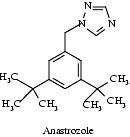
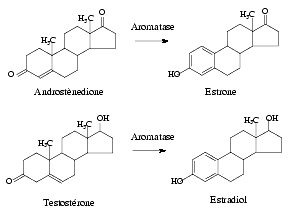
The inhibition of aromatase, the specific enzyme for estrogen biosynthesis, constitutes a good solution. Now there are many specific inhibitors of aromatase: formestane, letrozole, anastrozole and exemestrane.
- Aminoglutethimide
Aminoglutethimide, initially developed as an antiseizure agent, has been for a long time the only inhibitor of aromatase on the market. But its effect is not specific because it also inhibits the synthesis of other steroids, in particular the transformation of cholesterol into pregnenolone and different hydroxylations. When aminogluthetimide is used for inhibiting aromatase, it also inhibits cortisol synthesis whose deficiency must be compensated by the administration of a glucocorticoid.
- Formestane
Formestane or 4-hydroxy-androstenedione is a specific steroidal inhibitor of aromatase. It is intended for the treatment of breast cancer at a advanced stage in postmenopausal women, after failure of tamoxifen or intolerance to it. Among its adverse effects, one can note skin disorders, eruption, pruritus, and drowsiness.
- Letrozole
Letrozole, a nonsteroidal product, is a specific aromatase inhibitor. It inhibits the enzyme by binding to its heminic part. It lowers the concentration of estrogens in plasma and in neoplastic cells. It is prescribed for the treatment of breast cancer at an advanced stage.
- Anastrozole
Anastrozole is also a nonsteroidal inhibitor of aromatase. It is active at the dosage of 1 mg/day and seems well tolerated
- Exemestane is an irreversible steroidal inhibitor of aromatase. Its structure is related to that of androstenedione, substrate of aromatase.
Aromatase inhibitors are used in postmenopausal and ovariectomized women to suppress the remaining production of estrogens which is especially extra-ovarian (adipose tissue, liver, skin, muscle, neoplastic tissue). In women with functional ovaries, the inhibition of aromatase, makes estrogens fall, suppresses the pituitary negative feedback and elicits an increased release of FSH and LH which stimulate ovaries.
Inhibition of estrogen receptors, and SERM
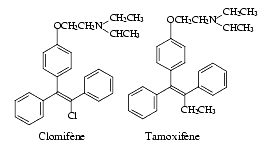
Estradiol activates all types of estrogen receptors but certain synthetic compounds, or their metabolites, have complex and sometimes opposite effects: agonist effects on certain receptors and antagonist effects on others. These compounds are called SERM for Selective Estrogen Receptor Modulators. The consequences of the inhibition of receptors also differ according to wheter it predominates at the hypothalamic-pituitary level or at the peripheral level. The first inhibitors were clomifene and tamoxifen, of similar chemical structure, which, in addition to their antagonistic effects of estrogens, have agonist effects, at the level of certain target tissues.
Hypothalamic-pituitary action
- Clomifene
Clomifene or clomiphene (Clomid*) is a racemic compound (isomers cis and trans), having estrogenic and anti-estrogenic effects. Its principal effect is to inhibit the negative hypothalamic-pituitary feedbach of estradiol. Its administration during a few days elicits a discharge of FSH, then of LH, likely to elicit ovulation. Clomifene is used for the treatment of sterility due to anovulation.
Before prescribing clomifene, it should obviously be checked that the woman is not pregnant, that she does not present polycystic ovaries, in which case the dosage should be reduced. She also should be informed that in the event of success, a multiple pregnancy is possible.
During clomifene therapy visual disturbances, blurring, spots may occur .
Peripheral action
- Tamoxifen
Tamoxifen (Nolvadex*) - via its metabolite hydroxy-tamoxifen which has a very high affinity for estrogen receptors - has anti-estrogenic effects in certain organs, in particular breasts, and estrogenic effects on others, endometrium and bone, via other metabolites. .Tamoxifen has a long half-life, approximately 7 days. It is used for the treatment of estrogen-dependant breast cancers. It reduces their recurrence and their resulting mortality. However, the emergence of neoplastic phenotypes resistant to tamoxifen or exceptionally stimulated by it, is possible. The causes of this resistance are numerous and very complex, the most frequent being the absence of expression of estrogen receptors. Tamoxifen is also used over long periods to prevent breast cancers in women of increased risk but it is suspected to increase the risk of endometrial carcinoma. If it is prescribed, a particularly attentive gynaecological monitoring is necessary.
Among its possible adverse effects, one can quote amenorrhea, digestive disorders,, thrombopenia and visual disturbances poorly explained, as those which one observes with clomifene. Before prescribing tamoxifen, it is necessary to eliminate the possibility of a pregnancy.
- Raloxifene
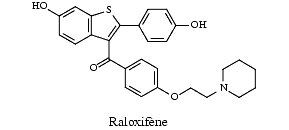
Raloxifene (Evista*) whose chemical structure is related to that of tamoxifen, has anti-estrogenic effects in breast and endometrium and estrogenic effects in bone. Raloxifene reduces the loss of bone and is proposed for the prevention of osteoporosis in postmenopausal women and could perhaps reduce the risk of breast cancers. It lowers total cholesterol and LDL cholesterol. Its efficacy and its tolerance are still to be defined in long-term use but it was well tolerated during clinical trials. It increases the risk of venous thromboembolism however and gives hot flushes.
- Toremifene
Toremifene (Fareston*) is a chlorinated derivative of tamoxifen indicated for the treatment of estrogen-sensitive breast cancer of postmenopausal women.
- Fulvestrant
Fulvestrant (Faslodex*) is a competitive antagonist of estrogen receptors used for the treatment of estrogen-sensitive breast cancer in postmenopausal women.
|