Antithyroid drugs
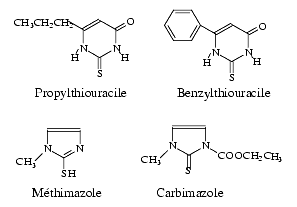
Synthetic antithyroid drugs used in therapeutics are on the one hand benzylthiouracil and propylthiouracil and on the other hand carbimazole and methimazole also called thiamazole. Carbimazole is converted in the body into methimazole which is the active molecule.
Effects
These compounds decrease the synthesis of thyroid hormones, but the clinical effect appears only after depletion of already preformed hormones in the colloid. They inhibit: thyroperoxydase, resulting in impairment of iodide oxidation and of coupling of iodothyrosyl residues to form iodothyronines T3 and T4.
Antithyroid drugs could also have an immunosuppressive effect resulting in a decrease of immunoglobulins responsible for stimulation of the thyroid receptors.
Benzylthiouracil and propylthiouracile inhibit, moreover, the conversion of T4 into T3 by peripheral tissues. Methimazole does not have this effect.
Therapeutic uses
Antithyroid drugs are used to treat hyperthyroidisms, i.e. the states of hyperactivity of the thyroid gland with overproduction of T4 and T3. This state is observed particularly in Graves' disease.
Graves' disease, does not result from an overstimulation of the thyroid byTSH, but of its stimulation by autoantibodies of IgG type. These immunoglobulins activate TSH receptors and increase the synthesis of T3 and T4. They also induce thyroid growth, giving a goiter. The overproduction of T3 and T4 has a negative feedback on the hypothalamic-pituitary complex and induces an important fall of the secretion of TSH. The decrease of the plasma concentration of TSH is a good marker of Graves' disease.
In the treatment of hyperthyroidism, antithyroid drugs are given during the initial phase at a high dosage, known as the attack phase. The beneficial effect appears then in a few days or two to three weeks. Then, during the phase of maintenance and the phase of consolidation, the dosage is lowered according to the improvement of the patient. The total duration of the treatment is one to two years.
The control of the efficacy of the treatment depends on the outcome of the clinical signs, in particular pulse and weight, and of hormonal determinations. A monitoring of the blood count is also needed because of the risk of agranulocytosis.
Besides the treatment of hyperthyroidism, antithyroid drugs have had other indications: for example, propylthiouracide could reduce, through poorly known mechanisms, mortality in patients with alcoholic cirrhosis.
Adverse effects
The principal adverse effect of antithyroids is, in fact, the relapse of hyperthyroidism: in one-third of cases. It was thought that the frequency of relapses could be decreased by the use of antithyroids in higher doses than usual, but this does not seem to be confirmed.
In patients treated with antithyroid drugs leucopenia is common and agranulocytosis not rare, it appears with fever and angina. It is necessary to control blood cell count and to stop the treatment if neutropenia worsens.
The other adverse effects are eruptions, arthralgia and other allergic manifestations.
The treatment of hyperthyroidism in pregnant women is not always necessary because the symptoms of hyperthyroidism attenuate during pregnancy. However, if necessary, carbimazole can be maintained in pregnant women at the lowest dose possible. The fetal thyroid becomes active at the eleventh week, thus the risk to induce fetal hypothyroidism during the first trimester seems low.
Antithyroid drugs must not be given to women who nurse, because they pass into milk.
Notice
Lithium used in the treatment of manic-depressive disorders can induce hypothyroidism by mechanisms not well known. This adverse effect led to propose lithium for the treatment of hyperthyroidisms.
|


