FSH and LH
Metabolism
FSH and LH are secreted by the pituitary gland. Their secretion is very low during childhood and increases at puberty when one observes an increase in both the frequency and amplitude of their peaks. Secretion is pulsatile in men and women, but the mean level remains constant in men, whereas in women it varies during the menstrual cycle with a peak level at midcycle. The frequency of the peaks of secretion of LH is higher during the first part of the cycle than during the second.
. 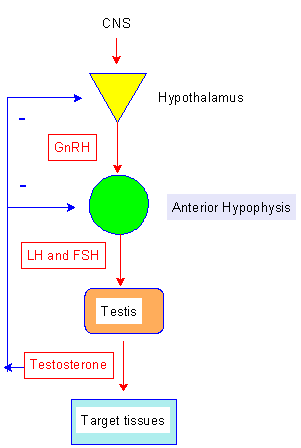
Regulation of secretion of FSH and LH
The plasma half-life of FSH and LH is two to five hours, longer than that of the majority of polypeptides.
Chorionic gonadotrophin is secreted at the onset of pregnancy by trophoblastic cells at the origin of the placenta. If there is pregnancy, seven days after ovulation its secretion is already increased and is detectable in urine before the date of the envisaged following menstruation. Pregnancy tests detect its presence in urine. Its secretion is very high in patients with trophoblastic tumor, choriocarcinoma and hydatiform mole.
The evolution of the concentrations of LH, FSH, estradiol and progesterone during the menstrual cycle is schematized in the following table.
. 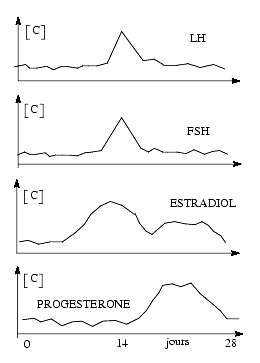
Evolution of the plasma concentration of LH, FSH, estradiol and progesterone during the menstrual cycle
Effects of FSH and LH
FSH and LH stimulate specific G protein coupled receptors present in the gonads. They activate adenylcyclase and induce in particular the transformation of cholesterol into pregnenolone.
- In women:
FSH induces the development of several follicles until the outbreak of a dominating follicle and increases aromatase activity and consequently the biosynthesis of estradiol.
LH acts in synergy with FSH for the maturation of the follicle and its rupture, i.e. ovulation. It stimulates the production of progesterone which is secreted almost exclusively by the corpus luteum.
Chorionic gonadotrophin has a LH activity and ensures the maintenance of pregnancy.
During pregnancy, from the third month, it is the placenta which secretes estrogens and progesterone.
- In men:
FSH is involved in spermatogenesis, has a gametogenic action with little effect on hormonal metabolism.
LH, also called ICSH (intersticial cell stimulating hormone), stimulates the synthesis and the secretion of testosterone by testicles.
Use
In women, the preparations with FSH activity and the preparations with both FSH and LH activity (hMG or menotropins) are used as inducer of ovulation for the treatment of infertility and to stimulate the growth of multiple follicles for in vitro fertilization.
In men, FSH and LH are used for the treatment of patients with oligospermy and low gonadotropins. Concerning male infertility, it should be known that the maturation of spermatozoa in the seminiferous tubules requires ten weeks and their transit in the deferent channels one or two additional weeks, which explains why the response to any treatment is delayed. Treatment duration is in general one or several months.
In children, from 4 to 9 years, with cryporchidism without anatomical obstacle to testicular descent, preparations with LH activity are used.
Available preparations
One distinguishes according to their mode of obtention several types of preparations:
- hMG (human menopausal gonadotrophins) obtained from urine of postmenopausal women and also called menotropins (this term must be employed in the plural because the preparation contains both FSH and LH).
- hCG (human chorionic gonadotrophin) obtained from urine of pregnant women, during the first trimester, having LH activity.
- FSH obtained from urines of postmenopausal women and called urofollitropine and obtained by recombinant DNA technique, known as recombinant and called follitropin.
- Recombinant LH, called lutropine.
Their dosage is not expressed in mass but in international units, i.e. in biological activity, measured by means of standardized tests.
|


