Growth hormone or somatotropin - Regulation of secretion
The secretion of growth hormone by the anterior pituitary is, essentially, under the control of peptide hormones secreted by the hypothalamus. The concentration of growth hormone in plasma presents peaks during the nyctohemeral with a maximum during the first hours of sleep.
Its secretion which is maximum in adolescence, decreases gradually during life to low levels in the elderly.
Stimulation, GHRH
The secretion of growth hormone is stimulated by GHRH, growth hormone releasing hormone, also called somatocrinin, secreted by the hypothalamus in a pulsatile mode and according to a circadian cycle with a maximum during the slow sleep.
GHRH acts by increasing intracellular calcium concentration in pituitary cells which secrete growth hormone.
The secretion of GHRH is increased during the slow sleep and stress. It is stimulated by hypoglycemia, arginine, dopamine, serotonin, alpha-2-mimetics like clonidine which was used for the treatment of short stature. Arginine, in large doses, taken in the evening at bedtime, has been used to induce its secretion.
The tests of stimulation of growth hormone secretion used for the functional exploration of anterior pituitary reactivity, are generally insulin hypoglycemia and L-dopa which acts after its transformation into dopamine. However, the dopaminergic agonists which stimulate the secretion of growth hormone in normal subjects, inhibit its hypersecretion in patients with pituitary adenoma. Thus, bromocriptine, a dopaminergic agonist, can be used to reduce an excessive secretion of growth hormone.
Stimulation can also be obtained by injection of an analogue of the GHRH like sermorelin which is used as diagnostic test for pituitary exploration.
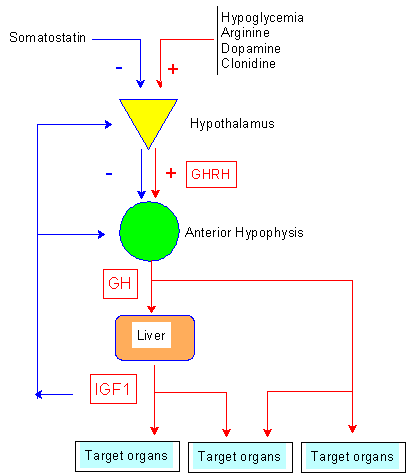
Growth hormone: regulation of its secretion
Inhibition, somatostatin
The secretion of growth hormone is inhibited by somatostatin also called SRIF, somatotropin release inhibiting factor, which exists in two forms, one of 14 and the other of 28 amino acids, present in the hypothalamus and the digestive tract. Somatostatins result from successive cleavages of a precursory polypeptide.
Somatostatin inhibits adenylcyclase and induces potassium exit out of the cell, which increases its polarization and decreases the calcium influx by the voltage/dependant channels.
Somatostatin inhibits endocrine secretions: growth hormone, insulin, glucagon, gastrin, VIP (vaso-active intestinal peptide), cholecystokinin, secretin, motilin and TSH.
It also inhibits exocrine digestive secretions (gastric and pancreatic) and reduces the intestinal absorption of amino acids.
It decreases splanchnic blood flux, lowers intrahepatic vascular resistance and pressure in esophageal varices in patients with portal hypertension, thus reducing the risk of bleeding.
In spinal administration, it could have an antalgic effect.
Somatostatinomimetics have several therapeutic uses:
- pituitary tumors and acromegaly: they could also be used for the treatment of certain cancers: breast, lung, prostate, because growth hormone could stimulate their development.
- carcinoid tumors, vipoma, glucagonoma. postoperative digestive fistulae, because it reduces digestive secretions.
- hemorrhages by rupture of esophageal varices in patients with portal hypertension, for example in patients with cirrhosis.
The clinical studies led to attribute to each somatostatinomimetic specific therapeutic uses.
Somatostatin, composed of 14 amino acids, is used for the treatment of hemorrhages by rupture of esophageal varices and of post-operative digestive fistulae. Its principal adverse effects are nausea, hypotension, bradycardia.
Octreotide, somatostatin analogue consisting of eight amino acids, is indicated for the treatment of acromegaly, secreting digestive tumors (carcinoid, vipoma, glucagonoma, other cancers) and for the prevention of pancreatic fistulae following surgical resection. It is also indicated for the emergency treatment of esophageal varices, while waiting for an endoscopic treatment.
Lanreotide, long-acting somatostatin analogue, has properties and therapeutic uses similar to those of octreotide.
|


