Glutamic acid effets - Therapeutic applications
Two groups of glutaminergic agents exist: directly acting which activate or inhibit glutaminergic receptors and indirectly acting which modify glutamate concentration in synapses (by modification of its synthesis, its release or its reuptake).
Glutaminomimetic agents
Glutaminomimetic agents could improve learning and memorizing, but their other effects linked to cellular depolarization are as a whole adverse.
Glutamate itself was used between 1950 and 1960 in order to improve memory and to treat mental retardations, without convincing results. Its use was stopped when it was shown that its administration to young animals induced nervous and endocrine disorders as well as lesions of the retina.
Compounds such as beta-N-oxalylamino-L-alanine present in the plant Lathyrus sativus, and beta-N-methyl-L-amino-alanine present in seeds of another plant, are activators of glutamate receptors and can induce neuronal degenerations, of which one is called lathyrism.
Glutamate release inhibitors
Lamotrigine is an antiepileptic which inhibits opening of voltage-dependant sodium channels and glutamate release ( See “Sodium and drugs”. ). used alone and as an adjunct with other antiepileptics for partial and generalised tonic-clonic seizure treatment.
Glutamate antagonists
As we saw, a certain number of compounds (zinc, magnesium) or tricyclic antidepressants can partly inhibit glutaminergic receptors.
Antagonists of glutamate are marketed or under study for possible use in Parkinson's disease where they may decrease akinesia and rigidity, of strokes, certain epilepsies, certain psychiatric disorders and Alzheimer's disease.
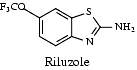
Riluzole has several pharmacological properties: inhibition of glutamate release and glutamate effects, inhibition of sodium voltage-dependant channels. Riluzole is indicated in treatment of amyotrophic lateral sclerosis (motor neuron disease) of which it slightly slows the course. Rise in hepatic transaminases is one of its principal adverse effects.
Memantine, is chemically a derivative of adamantane. Its structure approaches amantadine used as an antiparkinsonian and anti-flu agent. Memantine is a noncompetitive antagonist of NMDA receptors. It is used in the treatment of moderate to severe Alzheimer's disease of which it attenuates certain symptoms. Its dosage must be reduced in patients with renal impairment.
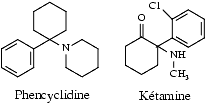
Phencyclidine, ketamine and tiletamine are inhibitors of NMDA receptors: they penetrate inside channels of these receptors during their opening and block them. It is not known if all their clinical effects result from this inhibition. Phencyclidine was tested in years 1950 as general anesthetic but quickly abandoned for various adverse effects among which post-operative delusion with hallucinations. In years 1970, it was illicitly used and induced various schizophrenic-type disorders and sometimes aggressive behaviour.
Ketamine was released on market as rapid-acting intravenous anesthetic of short duration. In certain patients it elicited psychomimetic disturbances (hallucinations, disorientation) on awakening. It is not used any more in human medicine but it is in veterinary medicine.
Tiletamine was not used in human medicine but it is in veterinary medicine.
Ketamine and tiletamine, marketed as veterinary anesthetics, are sometimes diverted and illicitly used. The psychotic-like disorders they induce can be treated by diazepam or a neuroleptic agent, olanzapine could be more effective than haloperidol.
Antagonists of the glycine receptor of NMDA complex.
Since the activation of the glycine receptor of NMDA complex is essential to action of glutamate, its inhibition could have antiglutamate effects.
|


