Benzodiazepines
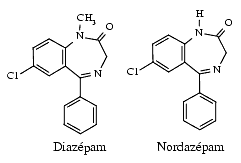
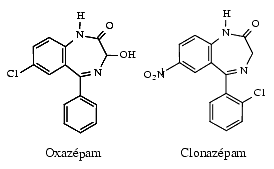
The chemical structure “benzodiazepine” is common to numerous molecules which differ by the presence of varying substitutes.
Molecules which do not have the benzodiazepine chemical structure can however have the same properties, the same mechanism of action and the same effects as benzodiazepines.
The majority of benzodiazepines are agonists which enhance opening of GABA-A receptor-channels and increase chloride influx in neurons and thus have an inhibiting effect. In fact, they increase the frequency of opening of the channels. Certain benzodiazepines, not used in therapeutics, facilitate their closing and are called inverse agonists. Other benzodiazepines can bind GABA-A receptors without activating them and are antagonistic to the preceding.
Current research suggests the existence of endogenous transmitters having agonist, antagonist or inverse agonist effects on benzodiazepine receptors.
Benzodiazepines which facilitate opening of chloride channel have common pharmacological properties: they have anxiolytic, hypnotic, anticonvulsant, muscle relaxant and amnestic effects. Consequently, they potentially have the same therapeutic uses and the same adverse effects. However differences between various benzodiazepines exist based on:
- pharmacodynamic characteristics: certain molecules have a dominating effect, for example an anticonvulsive effect relatively more important than other effects, the precise explanation remaining unknown.
- pharmacokinetic characteristics: onset and duration of action explain many differences between molecules and their therapeutic uses.
Classification according to therapeutic uses
Benzodiazepines are used for their anxiolytic, hypnotic and antiepileptic properties.
Anxiolytic benzodiazepines
The first benzodiazepine introduced in therapeutics in 1960 was chlordiazepoxide, under the name of LIBRIUM *. Its anxiolytic properties, called then tranquillizing, were well highlighted in animals and in human beings.
In animals, benzodiazepines decrease aggressiveness, exploratory behaviour in a new environment, physiological reactions to stress.
In human beings, anxiolytic effects of benzodiazepines are clearly documented. However, the pathophysiology of anxiety is poorly understood and it is not proven that it results from a disturbance of the GABA-ergic system. Anxiolytic drugs must be regarded as symptomatic treatments, used to relieve patients and to facilitate their adaptation to a difficult situation. The benzodiazepines used as anxiolytic are indicated hereafter.
Diazepam |
Valium* |
Bromazepam |
Lexotan* |
| Oxazepam |
Seresta*, Oxanid, Serax* |
| Clorazepate |
Tranxene* |
| Clobazam |
Urbanyl*, Frisium* |
| Alprazolam |
Xanax* |
| Prazepam |
Lysanxia*, Centrax* |
| Lorazepam |
Temesta*, Ativan* |
Anxiolytic benzodiazepines have a long half-life and are converted into active metabolites having also a long half-life, which explains the long duration of their effects.
Note: other anxiolytics
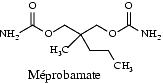
There are anxiolytic drugs without a benzodiazepine-like chemical structure, sometimes called tranquilizers, which were marketed before the introduction of benzodiazepines in therapeutics and whose mechanism of action is not well known, such as meprobamate, captodiame and hydroxyzine.
- Meprobamate was introduced in therapeutics in 1955. It has anxiolytic, sedating and myorelaxing properties, but its mechanism of action is not understood; it is not very selective for endogenous targets and to obtain an anxiolytic effect, it is necessary to use high doses, 400 mg by tablet, whereas a tablet of alprazolam contains 0,25 mg. The principal disadvantages of meprobamate are enzyme induction and in overdose, severe poisoning with sustained coma, against which one does not have antidote.
- Captodiame has sedating and antispasmodic properties.
- Hydroxyzine has many pharmacological properties. It is sedating, anxiolytic, H1 antihistamine, local anesthetic, antispasmodic and antimuscarinic (risk of glaucoma etc).
- Buspirone, anxiolytic with a serotonergic impact, was marketed a few years ago. It has no GABA-ergic effect ( See “Serotonin, serotoninomimetics, antagonists” ).
Hypnotic benzodiazepines
The sedating effect of benzodiazepines is recognized, they induce sleep and in general prolong its duration. During a sustained use, their hypnotic effect attenuates but does not seem to disappear like that of barbiturates. The sleep obtained under benzodiazepines has electroencephalographic features close to those of natural sleep. This point should not be used as argument to widen their prescription, because a sustained use produces an addiction. Moreover, the quality of hypnotic is not judged only on sleep, but on the state of the subject on awakening and during day, drowsiness or not etc, and on the possibility of adverse effects.
D.C.I |
D.C |
T1/2 |
| Nitrazepam |
MOGADON* |
25 H |
| Lormetazepam |
NOCTAMID* |
10 H |
| Flunitrazepam |
ROHYPNOL* |
20 H |
| Temazepam |
NORMISON*, RESTORIL* |
8 H |
| Loprazolam |
HAVLANE*, DORMONOCT* |
8 H |
| Estazolam |
NUCTALON* PROSOM* |
17 H |
| Triazolam |
HALCION* |
3 H |
Pharmacokinetics: benzodiazepines used as hypnotics have a rapid onset and a short duration of action. Among hypnotic benzodiazepines, triazolam is the one which has the fastest effect and caused adverse effects such as amnesia-automaticity.
Three drugs zopiclone and eszopiclone, zolpidem and zaleplon, largely used as hypnotic for n the short-term management of insomnia , have a benzodiazepine action (i.e. act on the same receptors) without having its chemical structure.
D.C.I |
D.C |
T1/2 |
| Zopiclone |
IMOVANE* |
6 H |
| Eszopiclone |
LUNESTA* |
6 H |
| Zolpidem |
STILNOX* |
3 H |
| Zaleplon |
SONATA* |
1 H |
Antiepileptic benzodiazepines
Clonazepam is a benzodiazepine and has their general properties, with a predominant anticonvulsive effect. It is used by oral route for the treatment of different types of epilepsy resistant to other drugs and of myoclonus. For the treatment of status epilepticus it is used by injectable route.
Clonazepam |
RIVOTRIL* KLONOPIN* |
Injectable diazepam is also used for treatment of status epilepticus.
Anesthetic benzodiazepines
Midazolam is a benzodiazepine indicated for induction of narcosis in general anesthesia. It has an instantaneous and a short duration effect. Its amnesic effect can be beneficial.
Midazolam |
HYPNOVEL*, VERSED* |
Midazolam can induce an apnea, which can necessitate artificial ventilation followed or not by administration of flumazenil.
Anxiolytic benzodiazepines are also often prescribed before surgery.
Pharmacokinetic features
Generally, benzodiazepines used as anxiolytics have half-life and duration of action (themselves and their active metabolites) longer than benzodiazepines used as hypnotics. Benzodiazepines used as anesthetics such as midazolam have a short half-life, about 2 to 3 hours. The metabolism of anxiolytic benzodiazepines is characterized by the existence of many active metabolites, in particular desmethyl diazepam and oxazepam

Metabolism of anxiolytic benzodiazepines
Adverse effects
As a whole, benzodiazepines are active and well tolerated drugs, especially when they are used judiciously.
At the onset of treatment with rapid-acting hypnotic benzodiazepines, particularly triazolam, especially when it was used in higher dosage than now, it can cause particular effects characterized by automatic behaviour, disinhibition leading to unexpected acts and anterograde amnesia. This adverse effect is explained by the fact that benzodiazepines preserve immediate memory but impair delayed memory. As short term memory functions, subjects adapt to situations, answer, act etc, but do not keep any memory of this automatic activity. This triad automaticity / disinhibition / amnesia are generally elicited by an unforeseen awaking, shortly after intake of the hypnotic benzodiazepine.
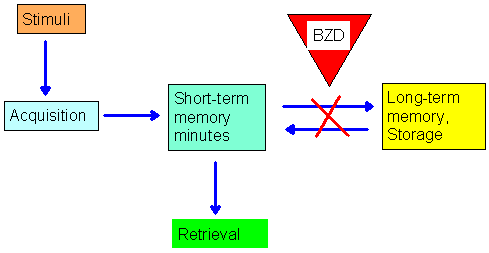
Effects of benzodiazepines, BZD, on memorizing
With repeated intakes, especially in large doses, drowsiness with possibility of degradation of psychomotor performances (driving, incoordination sometimes causing falls) and a certain emotional anesthesia were described.
Under certain conditions and in certain patients, benzodiazepines can induce paradoxical reactions: irritability, aggressiveness, excitation, confusion, hallucinations, pointing out effects of opposite agonist type.
The development of dependence to benzodiazepines is common and symptoms of withdrawal appear with discontinuation of intake of long duration and with high dosage. This dependence appears by a rebound of insomnia, with anxiety, agitation, myalgia, tremors, sensory distortions and even seizures.
In addition, taking into account their pharmacological properties, benzodiazepines can cause muscular hypotonia and respiratory difficulties. They should not be given to subjects presenting a respiratory deficiency.
Benzodiazepines, even if they attenuate certain symptoms observed during depressive states, are not true antidepressants and must not, in principle, be prescribed in isolation to treat a depressive state.
Benzodiazepines are not enzyme inducers. They potentiate the effects of alcohol. The intensity of their effects might be less in smokers and perhaps in coffee consumers.
Benzodiazepine antagonists
Flumazenil is an antagonist of benzodiazepines and of analogues such as zopiclone and zolpidem. Chemically, it is a benzodiazepine. Flumazenil has high affinity for benzodiazepines receptors, with little or no activating effect and displaces competitively benzodiazepines from their receptors and reverses their effects.
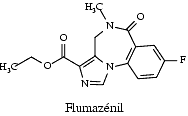
Flumazenil is given by intravenous route, its plasma half-life is approximately an hour, which explains its short duration of action.
Its therapeutic uses are as follows:
- In intensive care:
- differential diagnosis of states of coma of unknown origin to reveal those which come from a poisoning by benzodiazepines.
- treatment of poisoning by benzodiazepines.
- In anesthetics:
- interruption of a general anesthesia induced and maintained by a benzodiazepine,
- interruption of a sedation induced by a benzodiazepine used for short interventions.
- Treatment of hepatic encephalopathy where abnormal endogenous compounds could be involved as benzodiazepine agonists.
Flumazenil antagonises effects of benzodiazepines only for a short time. It is thus often necessary to administer it several times to maintain its effect because that of benzodiazepines is much longer.
Flumazenil |
ANEXATE* ROMAZICON* |
|


