Androgens - Metabolism
Biosynthesis
Testosterone biosynthesis depends on the pituitary hormones, in particular LH which induces the conversion of cholesterol into pregnenolone, which is metabolized either into 17-hydroxypregnenolone, or into progesterone which both lead to testosterone formation as shown in the precedingdiagram. A deficiency in 17-steroid reductase responsible of the conversion of the not very active androstenedione into active testosterone, induces an hypogonadism.
Distribution
- In blood
Released by the testes, testosterone enters into blood circulation where it binds to a plasma beta-globulin called sex hormone binding globulin, SHBG, which also binds estradiol; a larger part binds to plasma albumin with low affinity. There is an equilibrium between the bound form and the free form. Only the free form penetrates in tissues and is active but the form bound to albumin is dissociable and can become active. The concentration of SHBG in plasma increases during pregnancy. The estrogens increase the number of sites of SHBG for testosterone binding and thus decrease its active free form.
The plasma total testosterone concentrations are about 0.2 microgram per liter before puberty, from 5 to 10 in adult men and 0.4 in women. The measurement of the free testosterone which is about 2% of total testosterone can be useful in certain patients.
Testosterone inhibits the secretion of FSH and LH by negative hypothalamic-pituitary feedbach whereas dihydrotestosterone, because of its intracellular formation, does not exert this action.
- In tissues
Testosterone is taken up by sexual organs and other organs, in particular muscles.
In various organs, in particular sexual such as the seminal vesicles and prostate, testosterone is converted into dihydrotestosterone, also called androstanolone and stanolone. This transformation of testosterone, after its penetration in the cytoplasm, is catalyzed by the 5-alpha-androstane-reductase enzyme either of type 1, predominant in skin and liver, or of type 2, predominant in sexual organs.
Dihydrotestosterone formed in the cell binds to a cytoplasmic protein to form a dihydrotestosterone-protein complex which penetrates into the nucleus where it exerts its effects by interaction with a nuclear protein which modulates protein synthesis by activation or inhibition of transcriptions.
In certain pathological cases, testosterone is secreted in normal amounts but its transformation into dihydrotestosterone is not carried out because of a deficiency in 5-alpha- reductase, which results in a decrease of androgenic activity.
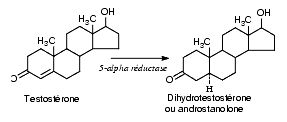
In other tissues such as muscles, the transformation of testosterone into dihydrotestosterone does not occur because these tissues have no or little 5-alpha-reductase activity and testosterone itself, after its penetration into the nucleus, modulates DNA transcriptions.
A small part of testosterone is transformed into estradiol under the influence of the aromatase enzyme. This transformation into estradiol is carried out in the testes and organs like the liver and is more important in patients with cirrhosis or hepatitis or hyperthyroidism. Contrary to testosterone, dihydrotestosterone is not converted into estrogen.
Biotransformations, inactivation
Testosterone is inactivated especially in the liver by several mechanisms: oxidation of the OH group in position 17 to give 17-cetosteroids, and conversion into androsterone, ethiocholanolone and androstenediol.
|


