Atropine
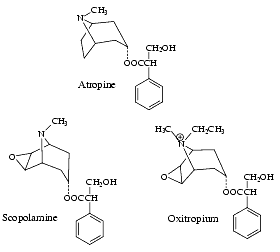
Atropine is an alkaloid extracted of the leaves of a shrub called Atropa belladonna, which acts primarily at the peripheral level.
Action on the autonomic nervous system
Atropine is a competitive inhibitor of acetylcholine muscarinic receptors. Its action results in a decrease of the parasympathetic tonus, so that the influence of the sympathetic nerve becomes dominating.
Cardiovascular action
- Cardiac action: atropine effect results primarily in modifications of the heart rate:
- in very low dose, it can give a slight cardiac slowing attributed to a central vagal stimulation and to peripheral parasympathetic effect leading to a transient increase of acetylcholine release.
- in therapeutic dose there is generally cardiac acceleration by reduction of vagal tone, and suppression of reflex bradycardia during arterial hypertension.
- Vascular action:, atropine does not have vascular effects since there is no parasympathetic tonus on the vessels but it inhibits vasodilation caused by an intravenous injection of acetylcholine.
- Action on the arterial pressure:
- in therapeutic dose, atropine does not induce modifications of arterial pressure in spite of incresed cardiac rate.
- in very high or toxic dose, it induces a fall of the arterial pressure by depression of the vasomotor centers and cutaneous vasodilation, perhaps secondary to an histamine release.
Eye Action
Atropine inhibits parasympathetic influence on the eye, which results in:
- passive pupil dilation or mydriasis and increase of the diameter of the iris.
- tendency to elevation of intraocular pressure by increase in the diameter of the iris which, in patients predisposed to narrow-angle glaucoma, obstructs evacuation of aqueous humor by the Schlemm channel . Atropine is thus contraindicated in these patients.
- Accommodation paralysis or cycloplegia, disturbing vision .
After local administration in the form of ophthalmic solution, atropine effects last very long: dilation of the pupil can persist several days.
Action on smooth muscles
Acetylcholine contracts smooth muscles except vascular muscles and atropine has an antispasmodic action by inhibiting this acetylcholine effect.
On the digestive tract, atropine decreases tone, amplitude and frequency of the peristaltic contractions; it decreases hypertonicity produced by morphine, which justifies its combination to morphine in the treatment of colic pain.
On isolated intestine, atropine gives a reduction of tonus and peristalsis, prevents and inhibits contracture elicited by acetylcholine.
Antispasmodic action of atropine is also exerted on biliary tract, bronchi, urinary routes: ureters and bladder. Urographies showed that atropine dilates ureters.
The bladder receives sympathetic and parasympathetic innervation. The sympathetic nerve tends to dilat the bladder and constrict its internal sphincter. The parasympathetic, on the contrary, constricts bladder and relaxes the internal sphincter. The suppression of the influence of the parasympathetic by atropine gives an increase in the tone of the internal sphincter and a dilation of the bladder, which can induce urinary retention, especially in case of prostate hypertrophy.
Atropine practically has no action on uterus.
Action on secretions
Atropine reduces the majority of secretions:
- Digestive: inhibition of salivary secretion results in a feeling of thirst, of dryness of the mouth. The reduction of gastric secretion explains why atropine was used in therapeuticsas a gastric antisecretory. It hardly modifies pancreatic secretion nor biliary.
- Bronchial: bronchial secretion is reduced.
- Cutaneous: it inhibits sudation, which gives a dry and hot skin. It is necessary to be wary about its use when ambient temperature is high or in patients with fever, because the inhibition of sudation increases temperature, particularly in infants, with the risk of provoking hyperthermia.
- Lacrimal secretion is reduced, lacteous secretion during lactation is little or not modified.
Action on central nervous system
In therapeutic doses, in human beings, atropine has only little or no action on the central nervous system, sometimes a respiratory stimulation.
Atropine was for a long time the only drug to have some efficacy in Parkinson's disease. In animals, it inhibits tremors elicited by cholinomimetic agents such as oxotremorine.
Atropine and scopolamine, lower the cerebral acetylcholine concentration in animal experiments: the inhibition of acetylcholine receptors elicited causes an exaggerated release of acetylcholine, which is hydrolysed by cholinesterases.
In high dose, the stimulant action of atropine appears with restlessness, ataxia, and +++++ , hyperthermia, dizziness, visual and memory disturbances, hallucinations, delusion. This picture can evoke an acute schizophrenic episode or an alcoholic delirium. However, in severe intoxication, a CNS depression and a respiratory arrest can occur.
Metabolism
Atropine is quickly absorbed by digestive route and one resorts to its administration by parenteral route only when one wants to obtain a very fast effect, for example in the treatment of colic pain. Its plasma half-life is of approximately four hours.
Part of atropine administered in the form of ophthalmic solution is likely to diffuse into the general circulation.
It crosses the placental barrier and traces can be found in various secretions, of which breast milk.
The duration of action of atropine administered by general route would be of approximately six hours.
Therapeutic use
Atropine has several therapeutic uses:
In administration by general route
- Treatment of painful syndromes with spasmodic component, i.e. involving an exaggerated contraction of smooth muscles, such as biliary and renal colic pain.
- In anesthesiology: prevention of respiratory tract secretion, bronchospasm, laryngospasm and reflexe reactions such as bradycardia, before surgical operations.
- Treatment of poisonings:
- by cardiac glycosides, to increase lowered cardiac rate
- by anticholinesterase agents and mushrooms of Amanita muscarina type, to reduce muscarinic symptoms. In poisonings by anticholinesterase agents such as organophosphorus compounds, atropine is administered in large doses in combination with pralidoxime.
Atropine is not used any more as a gastric antisecretory. After being used as a gastric antisecretory in the treatment of ulcer, atropine was replaced by a more specific muscarinic receptor antagonist of gastric secretion, pirenzepine which, itself, was withdrawn from the market because much more active products, acting by different mechanisms, were marketed.
Atropine and scopolamine were the first drugs used in the treatment of Parkinson's disease but they have been replaced by other muscarinic receptor antagonists such as trihexyphenidyl and, benztropine, and especially by L-dopa which has a different mechanism of action.
In local administration: ophthalmic solution
Atropine is a powerful mydriatic with a very long duration of action, now generally replaced by tropicamide
Adverse effects and contraindications
The principal adverse effects of atropine are a dry mouth, constipation, dryness of skin, tachycardia, mydriasis.
The contraindications are primarily glaucoma, because atropine raises intraocular pressure in patients with narrow angle, and prostate hypertrophy (difficulty in micturition and risk of urine retention ).
|


